Greater Tokyo Fieldnotes

This is a work of fiction. It’s fairly abrasive. The views represented are not the author’s. If you are not in the mood for fiction, you might scroll through this text and enjoy the pictures.
The morning of January 20, I awoke at the Smile Hotel in Fujisawa in a state of total discontent. Having lost my silk sleep mask the night prior, I had spent much of the night staring wide-eyed at the Wi-Fi router’s green flicker, the Toshiba TV’s red standby bead. Compounding this insult was the time: the laminate information sheet on the bedside desk said that checkout was at 10, and not the usual 11, making it just thirty minutes to checkout. I had never heard of a 10 am checkout, and it occurred to me, with a certain melancholy, that someone somewhere must have resolved to change the checkout from 11 to 10.
I turned the overhead light on, which could be accomplished from a switch in the bed. (Dawn had long turned to morning, its tendrils from pink to harsh white, yet the blackout curtains guarded against any luminous intrusion.) For each additional 10 minutes, the laminate information sheet continued, I would incur a 500 yen surcharge. If I knew in advance that I wished to take more time, the laminate sneered, I could go down to the information desk and request that they begin the bloodletting in advance! Though this surcharge was quite small, I could endure no such indignity and had dumped all my belongings into the vomit-green-carpeted hall by 9:50.
I had a very important meeting in Shimokitazawa that day about my book on declining fertility, and thus needed to budget my time accordingly. The truth was the book was a total failure, an immense source of nagging embarrassment, and yet I believed that in meeting my source, I could salvage something toward the final culling of this albatross. The book was, in fact, about Korea, but after a falling out with the South Korean immigration authorities (the least pleasant, and most shrill, of all Korean immigration authorities) in a backroom at Incheon Airport, I had decided to include the entirety of the former Japanese Empire as the subject of my inquiry.
My source had agreed to meet me at 2:00. It would have been prudent to take the train toward Tokyo and settle in before my meeting. And yet, despite having been in Fujisawa for three days, I still had not been to Enoshima. I knew well that if I did not see Enoshima, someone—perhaps my source—would ask me if I had been to Enoshima, and I would have to confess that I had never been to Enoshima. I had come so close, I would say, but professional commitments had sucked me back into the squalor of Tokyo. I could not stand for such humiliation. And so though it would have been far more convenient to simply go to Tokyo, I resolved at 9:47 am on January 20, four hours and pocket change from my meeting, that I would go in the opposite direction to see Enoshima.
I had my forty-liter backpack and a plastic supermarket bag full of nuts and other miscellany. I felt a curious unease looking into this bag of bags, all of which had been purchased at a supermarket in Memphis, Tennessee. It was always inconvenient bringing so many comestibles, but the truth was it was very hard to find the nuts I enjoyed most outside the United States. Pistachios, for example. Korea is almost barren for a pistachio lover like me, while Japan, having more American-style supermarkets, has more stores from which I can purchase my preferred pistachios, though still not nearly enough. The cumulative weight of these pistachios and other belongings was 25 pounds or so, which placed particular strain on my lower left back. Walking up the steps of the Fujisawa Station, I began to laugh at myself for this inane performance, for I was always lugging this miscellany through subway stations, even museums. I imagined one day security camera footage would emerge showing me turning abruptly and knocking over a Fabergé egg with my turtle shell bulge.
Upon arriving at Enoshima Station, I thought to take a taxi across the bridge, but in fact, this would have spoiled the great experience of crossing the bridge to Enoshima: one of the dozen or so best things that can be done in Enoshima, according to various gospels of Enoshima. I began to trot across the bridge in the cold, my caravan fully hitched. To my great surprise, I could see Mt. Fuji to my right, its white caps shrouded in gentle fog. I had never thought to go out of my way to visit the mountain, my interests being squarely anthropological, and yet here it had crept upon me. I found myself quite moved by this mountain, looming over the winter waves and crystalline light. The snow extends much farther toward the base than I expected, I thought. The truth was that I was in awe of this mountain, and indeed was beginning to have something of a spiritual moment. Yet the potential religion of this moment evaporated like morning dew when I observed the sheer number of tourists photographing the mountain, and found myself wishing nothing more than to knock their cameras out of their hands and into the frothy morning breakers.
A tourist village had sprung up on the slope leading to the shrine. A man rode up the hill on a Honda scooter, spewing clouds of exhaust upon the crowd, such that we were all bathing in the gasoline fumes and fried squid grease. Without my noticing, streetwalkers had begun inserting glossy pieces of paper in my hands, covered with pictures of bare-shoulder Japanese women making zen expressions. More steps to the shrine under the green foliage. I ignored the ablution station. That is not for you, I thought, walking up a second set of stairs, feeling a light sweat begin to trickle from my underarm. Though we must participate in even the most barbarous rites when they present themselves, like Ishmael with Queequeg, I contradicted, turning around and walking back down the stairs. I began washing my hands, dipping the wooden ladle into the stone vat. The water was cold against my face. It was 10:55 am.
Two rare statues of Benzaiten, a sign on a stone gate read: a tourist site within the tourist site. The rare statues’ container looked like a circus tent, built of vermilion pillars and white panels and green accents along the eaves. A golden knob atop the roof glittered in the rising sun. I felt an immediate compulsion to see the rare Benzaiten statues, which cost 500 yen to view, even as the broader shrine complex cost nothing at all. Once they get you in here, they know you won’t be able to resist, I thought, identifying their rather base, developing-world scheme. But if you see enough of these statues, you will begin to make sense of the broader Buddhist pantheon: a true intellectual feat, I reasoned. I paid the 500 yen and pushed into the circus tent, expecting to find the world’s smallest Benzaiten.
The first Benzaiten held a lute, and sat with a right foot raised to her left knee. I made a nod in her direction. The second Benzaiten had eight arms, each holding different objects of worship: a chakra, a sword, a staff, etc. Seeing her many arms I instinctively gave this Benzaiten a deeper bow than the lute-playing variant. Each sat behind plexiglass with dedicated donation boxes that I ignored. Since no pictures were allowed, I figured I should try to commit the Benzaiten statues to my memory, thus getting my full 500 yen’s worth. They didn’t expect that someone would smuggle Benzaiten away in their mind, I reveled. I began to study the statues, using various mnemonic tricks to usher them into my cerebral bag, to stow them in my ever-expanding cerebral British Museum, but this came to little avail, for the Benzaiten statues looked hardly distinguishable from the thousands of other Buddhist statues I had already pillaged (mentally). In fact, the two Benzaiten statues appeared to have no particular relationship, despite both purporting to represent the same deity. A Christian knows what Jesus’s father did for work, but a Buddhist cannot even tell you how many arms such-and-such deity has, I thought, recalling that I needed to start going to church again, even as—indeed because—I am totally immune to all the Church’s tricks. Yet even with the Christian Church under my thumb, essentially my plaything, I began to despair that I would never make sense of the broader Buddhist pantheon, what with the disparate naming practices, the inconsistent iconography, the sheer breadth, the increasingly dissolute state of my cerebral museum, which was always under siege by hostile forces. As a man walked in behind me, I fled the tent.
The Japanese people were bowing to the shrine as they exited, and I did a half turn and half bow, a kind of middleground that was neither farcical emulation nor gross ignorance, yet still wrong. There were two young (adult) women with skirts hiked up to their crotches. You could see the sun strike the backs of their pale thighs. I imagined that their thighs must have been very cold, even with the sun. I felt quite inspired that they would bear their thighs despite the inclement weather, so much so that I hastened my step to a full canter. I climbed down the stairs to exit the shrine, descending Enoshima’s ancient crags. The ocean turned turquoise in the gentle winter light. There was no beach, but a slab of igneous rock bubbled and swelled under the waves like some volcanic plot. Specks of sea spray dotted my face. I smelled no brine.
A family wanted me to take their picture. They saw that I was alone and decided they would exploit me as free labor. The father walked over and inserted his phone into my hand as he asked me to take their picture, as if to preclude the possibility of my saying no. I was now holding the phone, a Samsung Galaxy, in stupefaction, gazing upon his family of five as they began to pose for their photo. The three children, however, would not comply—they were climbing all over the rocks. But what if they should fall, I began to worry. The black slab was slick and darkened with sea spray, just as my shirt was with my own natural brine. They were getting closer to the ocean, to the violent froth. (They did not seem to be very strong swimmers, for none could have been older than 7.) Finally, the mother intervened; she grabbed one by the collar, then another. Right now, she said. I naturally began to sympathize with the children, for the mother’s tone sounded more shrill than that of the most vicious harpy.
After several minutes of sea herding, they began to stage their family photo. The mother and father stood in the back, arms around each other. They put on big fake hockey-puck smiles. I thought to tell them they should be frowning and cursing, for that would have been a more truthful representation of the moment they sought to capture.
The picture, I realized as autofocus squares ensquared the family’s mendacious miens, had no value, for beyond its total falseness, it documented only a cliché. There were millions of pictures like this, scattered over the globe, of this precise view of the Pacific. The father had traveled so far, all to take this picture that had been taken so many times before. Standing on the shore of Enoshima, he was no de Gama or Magellan—he was not even Aguirre. The truth was that he would never discover anything, for he would always be too occupied with diaper duty. But why had he come at all? The children were insensate to the cauldron of clichés they were being steeped in. No one was getting what they wanted, for the family had arrived at a familial compromise that rendered everyone discontent. He must have traveled here out of a certain delusion, I realized—the delusion that he could be de Gama and a pater familias. But such fantasy had been dashed mercilessly against the initial-carved rocks of Enoshima. As he came to collect his phone, I began to note his face, which before I had only registered as Teutonic. He must have been 35, but the crow’s feet, the hairline, all suggested he was much older. He looked very tired, giving me that particular look of a man being led to the gallows. Not fear, reader, but resignation. In staging this Japan trip, he had believed he could elude his fate, and now came his moment of anagnorisis, being pecked at by this harpy, being gnawed at by Cerberus.
It was now 11:22, and I felt quite sure I needed to turn around. I had now seen the Pacific both from California and from Japan, and it could be said that I was becoming something of an expert on the Pacific, save perhaps its center, which I could not be bothered to visit. Yet Enoshima’s caves were so close! If I left now, I would never get back to them. Of course, I could come back to the caves, but it would not be worth coming all the way to Enoshima from Tokyo for the caves alone. It made sense to come to Enoshima for the whole of Enoshima, but it made no sense to come simply for the caves, I realized. The truth was I had not even had time to consult the various gospels of Enoshima to learn which sea sutras had washed up in these eastern hollows. Nor did I know the depths of the caves—such spelunking could very well impinge on my very important meeting about my book at 2:00 pm. I was already at the ticket booth when I realized this. I paid the 500 yen, the woman in the ticket box granted me a wax candle, and I plunged into the dark.
After 30 meters or so, it became clear that I had been completely swindled out of 500 yen to see this cave empty of all but plaster dragon statues and Christmas lights. Several placards that had been hammered into the cave wall spoke more of Benzaiten, but in fact, the glare from the Christmas lights was so overwhelming, and the placard so worn, that I could barely make out the story of the five-headed dragon that used to skulk in Kamakura before she summoned the island of Enoshima to tame it. As I moved along the stunted corridor, I soon came to a dragon statue, where you could make a clap to elicit the dragon’s roar. A Walkman-era Sony speaker could be seen peeking out from behind several stalagmites in the corner. Before me, a line of Japanese women had arisen, having made the day’s pilgrimage to present themselves before the plaster dragon god. Each presented with a puffer jacket patched with a Royal Canadian seal. I began to feel some insecurity at the state of my wardrobe (ragged, rancid), which the dragon might regard as insulting to his majesty, yet I believed he would forgive the condition, given the immense length of my pilgrimage.
I watched as each woman came before the statue in short succession, bowed, made two claps, and formulated various New Year wishes. After five minutes of waiting, I waddled forward with my caravan of junk to present myself before the dragon statue, my bags rattling throughout the bowels of the cave. I bowed at forty-five degrees before looking into the plaster dragon’s eyes in a state of supplication: Oh, please release me from the obligation of this wretched book I have thrust upon myself! I thought. Seeking to emulate those before me in their barbarous ritual, I clapped in front of the plaster dragon to consummate supplication. Yet because my hands were full of bags and glossy massage parlor advertisements (my left hand), and a melting wax candle (my right), my claps did not resound sufficiently to trigger the dragon roar. A crinkled thwip. I tried it once more, again failing, realizing that the junk in my hands was muffling the clap to a frequency the Walkman-era sound sensor did not register. I thought to set aside my junk caravan and try again, yet seeing that it was already 11:44 am on my phone lock screen, and seeing that the present geographic context afforded me no excuse for being late to my meeting, I scurried away in shame, knowing well everyone had observed my total impotence before the dragon god.
I began my evacuation of Enoshima, climbing the steep steps until my heart throbbed so hard I believed it might go into cardiac arrest. Beads of sweat raced from my pits to my obliques, unimpeded by my baggy shirt. The truth was I had begun to revel in my impromptu workout, and indeed enjoyed being yoked like a mule to these bags, which seemed to be dragging me around all of Edo, more so than I was dragging them. Most people avoid this kind of labor, and all forms of labor more generally, even as it is precisely what they need, I thought, as my shirt rubbed against my back, already damp and cold, not unlike the sweated sheets I awake to in bed each morning. A shortcut afforded me another southward view of Japan’s coast, from which Mt Fuji had vanished behind a thick haze, as if to hide from the Fuji cameras perched like vultures on the bridge railing.
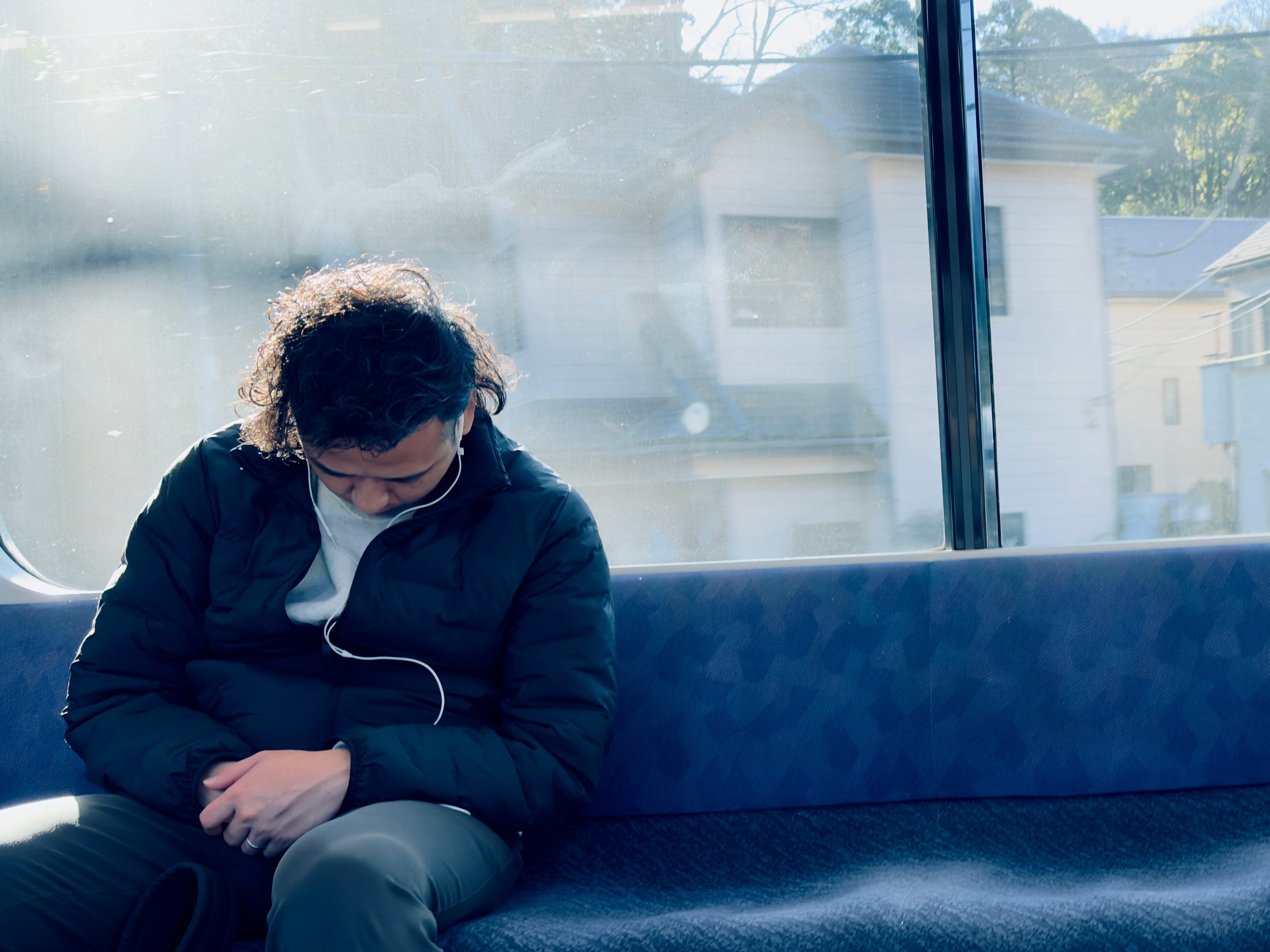
On the train, I watched a man sit sleeping, while green foliage slurred by in the rectangular windows with rounded corners. Occasionally, he would lift his curly head, only to check the time, in the same manner I used to while dreading my alarm in the morning. I would never again live by an alarm, I thought, humming the usual vagrant shibboleths. Of course, we need to narrativize our terrible life decisions, to tell ourselves that the values we organize our lives around have some higher value, when it is all just post hoc mythmaking. Oh, but reader, I hope you do not suffer the indignity of living by an alarm! There will be no alarm on your deathbed, I saw in a fortune cookie somewhere…
It was amidst these musings that I began to observe the curious connection between the man’s slumber and the windows, for at each interval, after checking his phone and returning to his stupor—not unlike clockwork—a new world would slur behind him, as if his very existence were a belated proof of George Berkeley. In his first vision, boxy, beige homes with gable roofs and shallow eaves arose, their practical fenestration affording no symmetry. This was all swallowed by his second vision, minutes later at 12:48 pm, of spry zelkovas and gnarled oaks, a green canopy through which telephone wires twisted like vines. But to all the train’s onlookers, it was the third vision, just before 1, of that proved his most masterful, for here one encountered total bounty, even amidst winter destitution: a grove of persimmons, spilling into the asphalt lot of an Aeon supermarket, orange globes beckoning the magenta latticework, stacked by the automatic door.
At 1:23 it occurred to me that I had nowhere to unhitch my caravan before my meeting. I could not possibly lug the caravan around in the presence of my source, but I still had not booked a place and had nowhere to leave my belongings. I will have to use the coin lockers at Shimokitazawa Station, I thought. But such coin lockers, in such a wretched tourist trap, could well be full, I despaired.
Upon arrival at 1:31 pm, I found that all of the coin lockers were indeed full. I resolved that I would wait for someone to collect their belongings, or else leave my things in the Starbucks, and feign suffering from some form of mental impairment when I arrived later to collect. (I was very jetlagged from the flight, I would say to the barista, as we both laughed.) Before committing to a course of action, I began to pace in front of the lockers, almost hoping, though not quite allowing myself to indulge in such foolish anticipation, that someone might come collect their belongings. The crowds afforded me almost no room to pace in comfort. I kept getting bumped by large Australian men, each sending a shockwave through my strained, sweat-stained lower left back. The truth was that I would have much preferred to visit my source in their hometown, Kawasaki, yet we must meet people in places where other people meet people, so as to signal that we know where we are supposed to meet people. It is very important to our appearance that we agree to meet people in the most crowded, expensive, and vacuous places, where everyone can behold that we know what the most crowded, expensive, and vacuous places are. I began to feel a certain melancholy, getting hipchecked by these Aussies, for Kawasaki was a real Japanese place, while Shimokitazawa was essentially a spectacle for people who had no interest in the lives of Japanese people, but needed lots of commercial stimulation to compensate for their total disinterest in human beings.
At 1:35, I decided to make the Starbucks my storage locker. I hauled my caravan up the station stairs. My backpack kept banging into various Japanese people. I cannot bear it ventrally.
A proper human menagerie in the Starbucks: Aussie armadillos and Balkan bats twisting tails at the wet market. They’d come all the way to this Japanese Brooklyn for Starbucks, I marveled, noting that none of them appeared to be using the place as a storage locker, and thus enjoyed no excuse like mine. Of course, I am not one of those people who build an identity around resisting chains. Starbucks is, frankly, an excellent company. Starbucks is, frankly, an excellent institution, I corrected, resting my hand on the belted stanchion of the order line, exposing myself to novel plague variants. If Starbucks were not an excellent institution, it would not have colonized the hippest Japanese cultural quarters, I told myself, as the woman before me reached for a Rice Krispies treat. (She had no business eating this Rice Krispies treat.) The truth was that I would have relished meeting my source at a Starbucks in Kawasaki, where the presence of a Starbucks would have had narrative coherence. The Starbucks in Kawasaki would have been the ideal stage for my grotesque colonial theater, I said to myself. But a Starbucks in Shimokitazawa essentially defeated the purpose of Shimokitazawa, even as that purpose (indulgence, spectacle) was itself completely hollow.
At the counter, I ordered an iced coffee as a pretext for my storage scheme. The cashier, completely hoodwinked, needed to know my name.
“Roburtu,” she said.
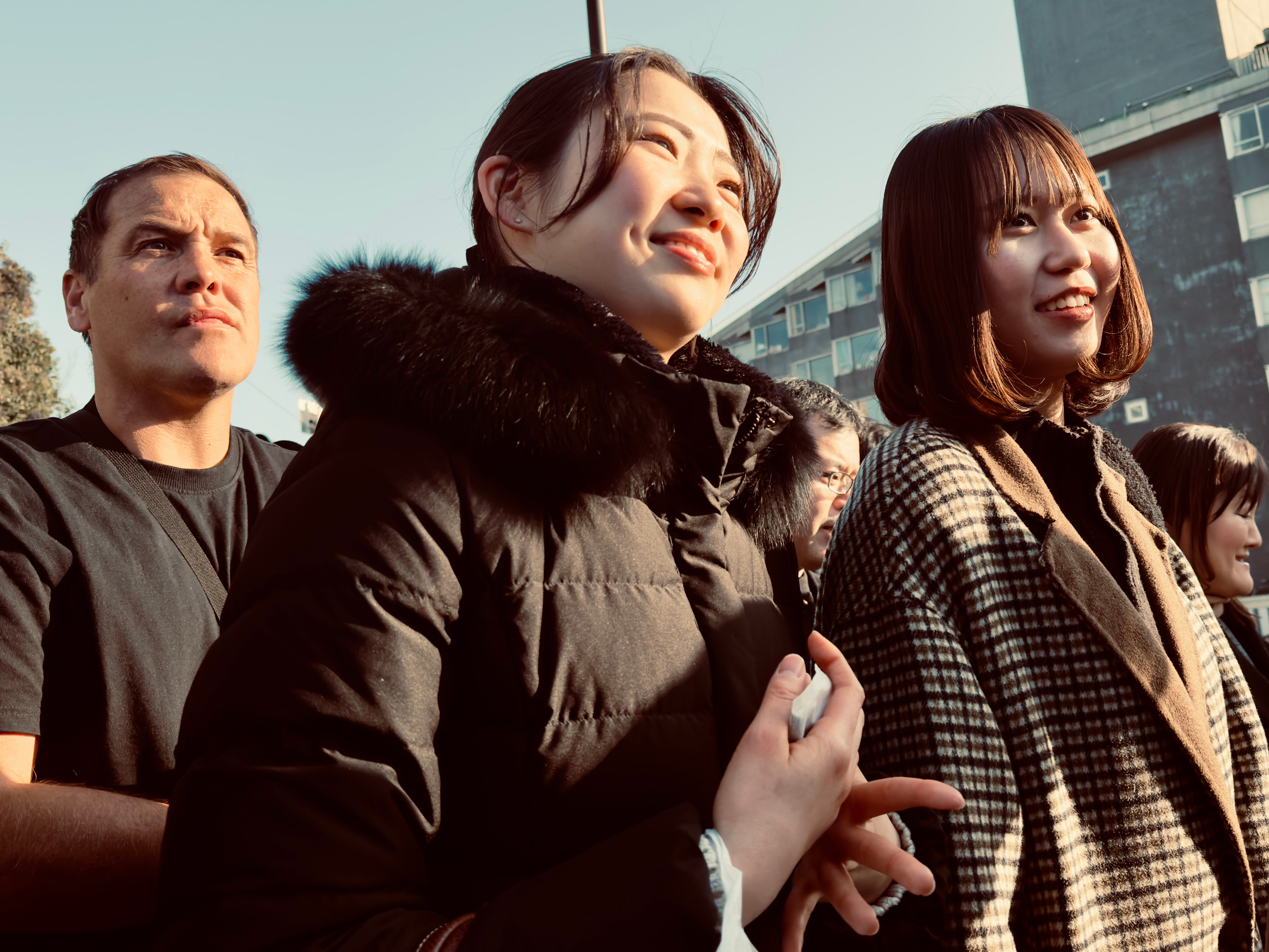
I nestled between two smiling Japanese women at the communal Starbucks table. I counted three Japanese people in the Starbucks with reusable Trader Joe’s bags, though there is no Trader Joe’s in Japan. I opened Twitter and began to catch up on what was happening in the United States, a nasty habit I have. There was a video of a shooting, with a frame-by-frame breakdown, as for a pass interference call in a football game. I opened the video, and gunshots rang out over the Starbucks, as I frantically smashed the button that lowers the volume. (There is no name for this button.) All of the Japanese people cowered at the noise and gazed upon me in horror, as if I had just kicked a small animal across the room. A terrible thing happening in the States, I thought, shaking my head. A total mess, I said, such that the smiling Japanese woman looked at me, never undoing her grin, as though it were a rictus.
I made a retreat to the bathroom. All of the urinals and stalls were full, so I resolved to simply wash my hands of the novel plague variants. As I activated the automatic faucet repeatedly to use as much water as possible, I looked into the mirror above the sink, which reflected only my torso. It was a repellent sight, not least because of the beige cardigan. The cardigan had been a disingenuous attempt at fashion, purchased at a Uniqlo at some oriental mall. In fact, if I were true to myself, I would have worn nothing but basketball shorts and t-shirts. The cardigan did nothing for my figure: it puffed out and ballooned around the midsection as if to make me appear like the muffin man—exactly what they wanted, I realized. With a t-shirt, by contrast, it was quite apparent that I was in fairly good shape—exactly what they hated, I knew. A woman had once latched onto my arm after just an hour because I was wearing a t-shirt. This never happened when I was wearing the cardigan because the cardigan created a tent, which could contain wads of dough for all an onlooker knew.
I waited until a Balkan bat finished washing its wings to examine myself in the full-body mirror of the entryway, which still occluded my head. The gauche fit of the cardigan was still less of an affront than the soiled state of the pants, which had been mottled with coffee stains and supermarket soy sauce. The truth was that I used to have a wonderful pair of burgundy corduroys, yet my mother had shrunk them while doing laundry during Christmas. The truth was that I had known well that my mother could not be trusted with these regal threads, as even in my earliest years, our laundry room seemed to exist for the explicit purpose of destroying my already pathetic wardrobe. (Beyond the many pants that were shrunk, some, more inexplicably, became ripped, as if operated with a pair of hedgeclippers.) I had thus told my mother several weeks prior to this meeting that it would be very useful if we could get these burgundy corduroys a cool, gentle wash. Yet upon stuffing into the corduroys at the Smile Hotel the prior morning, it had become clear that she had scalded them into the form of jockey pants.
My important meeting was in nine minutes. After stuffing my bags under the communal Starbucks table, I descended the steps of the station’s second-floor food court, arriving before the east gate. Tweeded women with wire-frame glasses; lip rung men with baggy army pants. (The Aussies, of course.) I texted my source that we would meet at the east gate if that was okay with them. I considered the proper interval at which to text such a person: to text too frequently would signal a kind of desperation, the thing I must conceal, I thought.
I began to review my source’s pictures, so I might be able to pick them out from the crowd. I began to imagine how my source’s flesh would diverge from the pixelation of their flesh, which naturally led me to ponder this most curious inversion: that our world revolves around matching flesh to screens, and not matching screens to flesh: we see something on a screen, and then we attempt to find which flesh looks most like the pixels. We used to match screens to flesh, but at some point, we began matching flesh to screens. I realized this with bemusement that quickly gave way to disgust. Of course, we used to do this for criminals, but now we did this for even ordinary acquaintances. We used to reserve flesh-to-screen matching for people with names like “the Golden State Strangler,” but now we did this even for our future…
A woman suddenly leapt from my periphery to the center of my pupils.
“Hello!”
This abrupt greeting startled me such that I had to put my hand on the woman’s shoulder, both to brace myself and as a form of self-defense.
Her face matched the screen reasonably well.
“You are Mai,” I said.
She confirmed she was Mai.
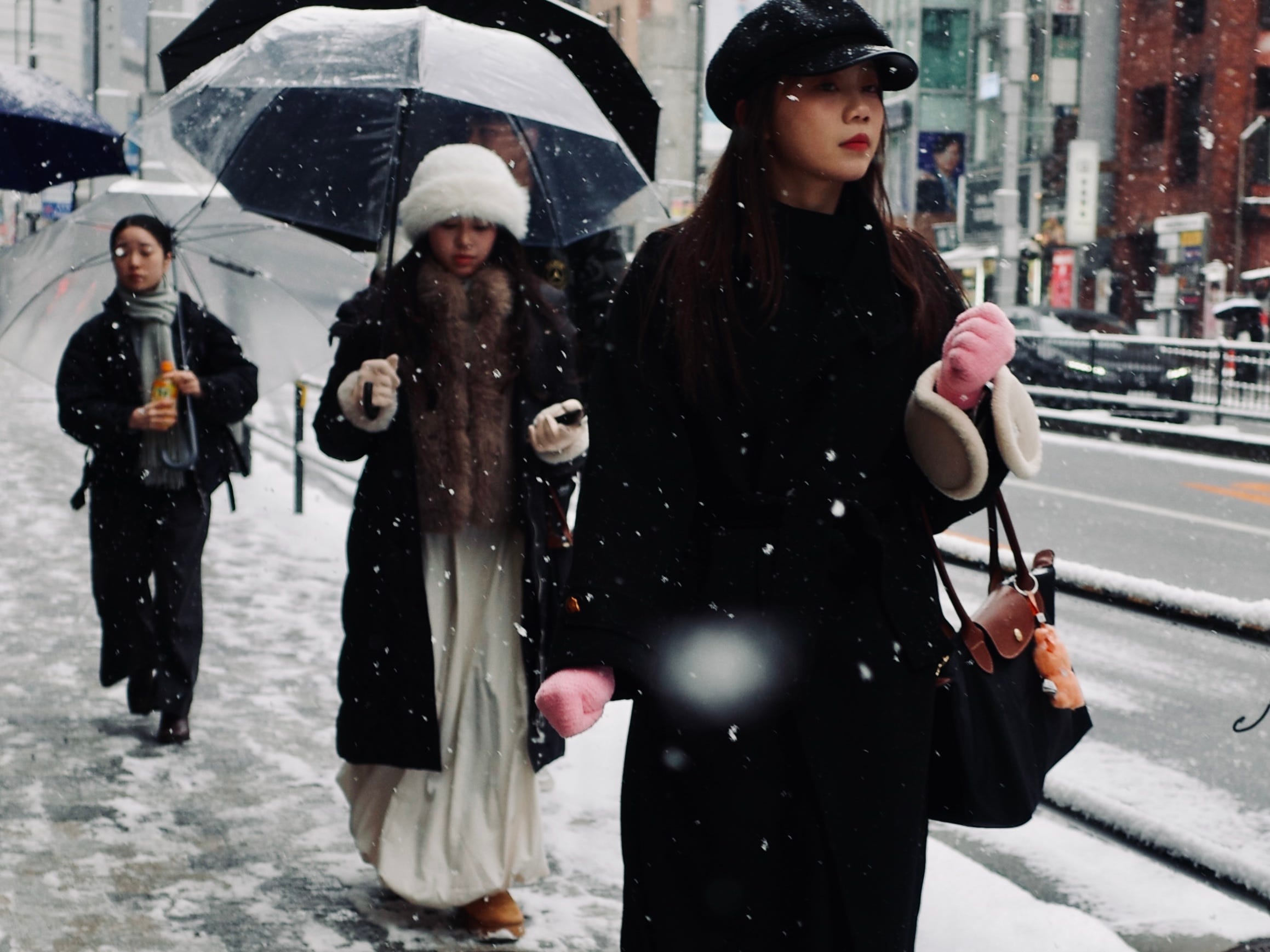
My source was wearing a black coat and black beret, pink-gloved hands toting a brown leather bag. Wine red lips, I thought. I told her that she had a great sense of fashion. She complimented my stained khakis and parachute cardigan in turn.
“Should we get coffee first?” I asked.
“That sounds good,” she said.
We began to walk. Yet I was so fixated on making acquaintances with my source that I was walking in the manner of a Roomba, breaking in the direction of any and every new sign that connoted coffee. As I began to wander off the reservation, Mai asked me if I had the slightest clue where I was going. I said that I certainly did not, and turned around to steer us toward a single cafe.
The cafe I landed on—Cafe K—seemed to have no particular aesthetic, save some affinity for the Latin alphabet in its Germanic formulations. We climbed steep stairs to its second-floor real estate, and through a sliding door, pressed into a shop outfitted with honey-colored wood floors, beige wood chairs, mahogany tables. Several of the tables had reservation signs on them.
“Do you want to get a pancake?” she asked, pausing before the menu pasted at the front.
“I’m okay.”
A matronly man, white aproned, yellowcaked with great globules of pancake batter, took our order from a kitchen window. Mai ordered a latte. I added an iced coffee. As the man began to inquire about the division of payment, and Mai began to reach into her oversized bag of bullion, I immediately inserted my silver Charles Schwab Debit Card, the one tapped into various margin loans that are slowly leveraging me to the brink, into his hands. She began to remonstrate.
We sat at one of the non-reserved tables. Between us there was a small vase, with four purple blossoms and three green stems resting against a glass neck. Mai placed her pink gloves on the lacquered mahogany. The matronly man served us dark brown coffee with light-brown napkins and red-brown cafeteria trays.
“I still don’t know what you do,” I said.
My source had worked for years as a dancer, a surprise, because she had noted her penchant for dancing before in passing, and I assumed this was a hobby, in the same way my writing was by all legal accounts little more than a hobby. When I had asked which kind of dancing she liked, she had said she danced nonsense. The sheer frivolity of this response had struck me as among the most enchanting responses ever delivered via a test message, yet it certainly understated her dancing capabilities.
“What did you perform in?”
“Do you know Madama Butterfly?”
“Puccini,” I said, beaming like a Jeopardy contestant. “I can’t quite recall how it ends, but I have always been a fan of the Weezer album.”
“That was probably the biggest production I was in. They needed lots of Asian women as extras.”
Her face turned solemn.
But the truth is, I never enjoyed the stage that much. I could never stand the spotlight, and so I settled for being an extra in most things. But that is a very healthy thing, Mai. A person who is always trying to seize the spotlight is likely to suffer from profound defects of the psyche: narcissism being the obvious one. Yes, but my parents wondered why they spent all this money if I was just going to skulk at the back of the stage. My father came to New York to watch my performance in Hairspray, and said he couldn’t even see me. But do you still dance? Only for fun. What 20 years of dancing taught me was that the concept of professional dancing was a kind of oxymoron, an Apollonian imposition on what was fundamentally Bacchic. But it’s not such a crazy concept, Mai—I once knew a man who sat for a licensing exam to become a professional clown.
Mai wished to know where I published my writing. I began to circumlocute that my writing was published independently. The truth is that it’s very hard to get commissions for the writing I want to do, I said, as she looked on in disbelief. It is not for want of imagination or quality, I assured her, averting my gaze, but for the willingness to gaze beyond one’s own navel: the natural habitat of the American journalistic class.
Seeing her persistent incredulity, I took out my phone and looked for a headline that illustrated the impetus for my state of exile. With no particular effort, I found a headline that said, “The ‘One Other Thing’ That Comes With Every Trump-Era Dinner.” As I read the words, I began to massage a scab on my finger from my shaving accident in Mokpo. I told my Japanese source that she needed to read the article, no matter the state of her English. The screen is very dim, she said as I handed her the phone. Reaching across the table, nearly knocking over the brown-bottomed tumbler, I manually increased the brightness until it emitted a faint white glow against her lightly tanned face. I watched as she bathed in the glow of this luminous agitprop, fearing that it might well induce some kind of sensory overload. Yet after several minutes of reading the article from my phone, she said she could not understand in the slightest what it was about, but that it sounded like the maniacal ramblings of a person experiencing homelessness, among other thuggish dregs of humanity. Upon the issuance of the verdict, we laughed like old friends at the gross vulgarity and provincialism of the American journalistic class, who had reduced themselves to little more than tabloid sneerers, who could do nothing but drown in their own navels, who would never have such splendid Japanese sources who had once starred in a Broadway production of Madama Butterfly!
She handed me back the phone.
“But what do you do now?” I asked.
“I got a job in production.”
“That sounds interesting.”
“It’s very boring.”
“What are you working on right now?”
“A talk show about black music traditions in the US.”
“I’m from Memphis.”
“Sugoi!”
I stared at her.
“It means awesome.”
She was now holding her phone before my face. In the picture, there was a small Japanese woman next to a wax figurine of Elvis Presley.
“When I did my roadtrip through the US, we went through the south,” she said. “I think my favorite place was New Orleans.”
“It’s very French,” I said, stabbing my gums with a straw.
My phone said forty minutes had elapsed: the ideal amount of time to make introductions. I suggested that we proceed to the matter at hand.
But first, we each needed to use the restroom. There was a single unisex toilet in the corner, with a sign for a man, a woman, and a man whose legs had ceased to function.
“You can go first,” I said.
“No, you,” she countered. “You paid.”
I walked further into the dark corridor. The door at the end was very short, and crossing through the threshold, I knocked my head against the jamb, muffling an invective between my teeth. The bathroom before me was a white igloo with all the tasteful accoutrements: pined potpourri, a plastic holly fern foregrounding a yellow-rodded plunger, a stick-on air freshener in the freshly flushed, Toto-branded bowl. I unzipped my mottled khakis and proceeded to urinate in the typical fashion, taking great care not to add any fresh splotches. Everything was indeed quite typical with respect to my urination. But for the immense amounts of coffee and tea I had drunk, my urination endured so long, and with such resonance, that I began to worry about its obscenity. Seconds raced by! Each time my urination came to a natural stopping point, a squeeze of my kegel muscles revealed more urine to be dispensed. After a minute of stops and starts, I finally resolved to cease my urination for good and finish it at another location.
It was only after my arrested urination, however, that I took full stock of the toilet, which, like many Japanese toilets, is less a toilet in the American imagination than a scatological computer. On the wall’s plastic paneling, I could discern no flush button, for the owner of the cafe, apparently a lost soldier of Hirohito, did not have the courtesy to clearly indicate in ecumenical fashion which of these myriad buttons might clear the waste. After the immense length of my urination, my inability to find the handle, button, or drawstring with which to flush the toilet had now lasted for over a minute, and the cumulative stay in the bathroom had reached definitively obscene lengths.
In a state of panic, I began indiscriminately pressing buttons on the cryptic paneling, making a flat palm and wiping across it so that no button could possibly remain unpressed. As in a dentist’s office, water began squirting from novel apertures with gentle gurgling noises and drill-like motor torque, as I watched with dreadful fascination until, to my great relief, the bowl’s tawny contents began to swirl. I proceeded to wipe the heated seat of several stray specks and immediately left the bathroom without washing my hands.
I found Mai still seated at the table. She said she no longer needed to use the restroom.
The matter at hand was that we were to look at the vintage shops in this Japanese Brooklyn. The truth was that I had no idea how to do this because I had never in my life walked around a neighborhood to explore vintage shops. My home, a sort of vintage shop in its own right, is so filled with dinosaur fossils, Argentine meteorites, gaucho prints, taxidermied cats (big ones), Yoruba mask carvings, Chinoiserie, tuneless ivory-keyed pianos, empty reliquaries, and poorly impressed impressionist works (to say nothing of my mother’s wardrobe, which, quite unlike my own, was so stocked and so meticulously maintained that it was swallowing her boudoir like kudzu) that I simply cannot imagine why anyone would want the burden of owning old things. The further truth was that this whole notion of thrifting was a terrible idea with respect to my fieldwork, for there was no way to gauge how much I should have been looking at the Americana compared to the Japanese person I had just met.
“How did you get into thrifting?” I asked.
“When I was still dancing, I would go thrifting in Brooklyn. I bought these gloves there.”
She extended her woolen fingers like a fresh manicure.
Most of the vintage shops only had men’s clothes. I wished to find a store that had something Mai could wear. We finally came across a store with red and green paisley dress racks under an awning. The lady at the counter ushered us in with a preamble of no particular translation.
“My aunt in Italy wears dresses like this,” she said.
I despaired that I might never get to meet this Japanese aunt who lived in Italy and wore such wonderful dresses. A Japanese aunt who lives in Italy is among the most cherished characters one could have in their lives, I thought, fondling silk lace.
I began to realize, around 2:53 or so, that there was no particular method to this thrifting performance. We would walk into a given store, wipe our hands on the fine brocades and leather varsity jackets, and wait to think of something appropriate to say. But there was not much to be said. As a rule, there is very little to be said. Most conversation is empty prattle, the product of an interpersonal equilibrium aimed at minimizing the risk of being disliked, especially upon a first encounter. In this case, it was all the more empty because I liked Mai, and we save our most craven manipulations for those we seek to endear.
“Did you like Fujisawa?” she asked.
“There’s not much to do, besides Enoshima.”
“But I heard it was a great place for families.”
Mai saw the film poster for The Silence of the Lambs in the window while walking between shops. She stopped me and said she was reading the book that inspired the movie. It was tolerable reading such a book because you did not have to look at pictures of Hannibal Lecter skin suits and such.
“I didn’t use to like scary movies, but now that I’m getting older, I don’t mind them as much,” she said.
I confessed to her that as a child, I had such a penchant for these movies and sought out the most heinous with all the gusto of a young de Sade.
“I shouldn’t say that,” I said. “It makes me sound like a serial killer.”
We came across a rack of sweatshirts, one of which said Columbia University. Immediately, I felt this strange sense of triangulation that her favorite city was New Orleans and that she had lived in New York City, because I once had a friend from New Orleans who had attended Columbia. I explained to my Japanese source my curious relationship with Adam, who I had met at summer camp, and who, by great coincidence, had the same worthless major as me in college. We both studied classics, which is to say we both came from southern merchant families who could bankroll this kind of academic indiscretion, I explained. Adam was half Jewish, whereas my mercantile sympathies owed to the New York Dutch. And so curiously, though we were both southerners, we were in some deeper sense southern transients: we viewed the south as a place to simply accumulate funds for the purchase of fine portraiture, and cared nothing for the vulgarity of SEC football, I explained to the Japanese woman. It sounds like this friend had a great influence on your life, she said. Most of all aesthetically, I averred. For while I am straight as an arrow, Adam was gay as a goose, and introduced me to music like Crystal Castles.
We had exhausted the Cleveland Browns memorabilia shops, so I said we should go to another cafe. I turned down a side street coming before a shop full of bookshelves and Eames chairs and lamps that suspended in the dark like stalactites. All the chairs faced bookshelves as if to preclude conversation. I told her perhaps it would be better to find another place. As we turned around, she suddenly said the current cafe seemed cool, but by now I had committed to the narrative that the coffee shop was not suited to conversation and there was no turning back without looking like a hapless fool. Yet, as a kind of reflex, I had begun to return to the coffee shop upon Mai’s saying it seemed cool, only to turn around again after realizing that this would have made me look indecisive, thus creating the impression that I had the proprioception and general wherewithal of a man with a railroad pike lodged in his skull.
The next coffee shop was a block away. She was now thanking me for my navigation. It made not the slightest sense that I would lead her around, but evolution had thrust this inanity upon us.
We climbed the stairs, and I peered into what looked much more like a bar than a coffee counter; the room was bathed in a warm, ambient light. Everyone appeared to be smoking, and I had no desire to sit in a room full of smokers. (I have always wished to occupy figurative smoke-filled rooms, but not literal ones.) But by now I had already backed out of one cafe, and there was no turning around again without looking like a doubly hapless fool. My salvation came when the man at the counter gleaned from my neotenous skin that I did not belong in such an establishment, and waved the camel between his two fingers to say get lost.
I thought the cafe down the street looked more welcoming. The sign featured a cartoon rabbit, and the interior was white with the odd carrot-colored flourish. I attempted to lunge in front of Mai to hold the door, but she had already pulled its handle, such that I was hovering over her five-foot frame, not unlike Nosferatu, pulling the door with her. Sprinting farther ahead of my chivalry still, she clarified with the employee at the counter that the store was a cafe. I could not understand why she asked such a question because the name on Google Maps quite clearly included the word cafe. The woman assured Mai that the cafe we were in was indeed a cafe.
It was only when we went upstairs that I realized the cafe was devoted to the children’s character Miffy, that lapine atavism of Dutch colonial power in the Pacific, with the cafe’s coffee-drinking component being a sort of afterthought for parents. Several tables orbited a playroom with boxes of blocks and other forms of stimulation for ages one to three. A black-haired toddler was rolling about on the blue foam mat, blocks strewn in every direction, while his mother observed from a table. The child looked like he was the king of this little Japanese Brooklyn, a reign that could be achieved in neither the real Brooklyn nor the Korean one. I joked that if Korea had such cafes, maybe they would have more children, though of course, this was supply meeting demand, and not supply driving demand.
“Did you like Miffy as a kid?” she asked.
“I always liked Babar.”
“I was a Harry Potter kid.”
Mai was impressed that I could pronounce her name with two syllables, instead of the single syllable most hapless foreigners would default to. It was, of course, a gross violation of local etiquette that I would call her by her first name, and indeed, each time I uttered the two syllables, an image of myself trampling a bed of chrysanthemums flashed before my eyes. But she had expressly asked me to use this name: she had seeped in the filth of Queens, and now she wished me to use the garbled street speak of an Italian immigrant on her. You say my name so well, she said. If there is one fact which I know about human beings, Mai, it’s that they like the sound of their own name, I said, recalling the Wikipedia page on Dale Carnegie I had once read. But what I had noted privately but heretofore not noted publicly was the nominative determinism of her name, or that she had simply granted herself a fake name that matched her erstwhile profession.
“Your name means dance,” I noted.
“I guess my parents should have named me doctor,” she said, curling a coy grin.
A new family emerged from the staircase, terrible two in tow, as Mai and I watched with rapt attention. The new toddler, dressed in a beige cardigan and burgundy corduroys, immediately lunged toward the playmat. Facing no resistance, he began laying waste to the first child’s inane block formation, devoid of both formal execution (many of the blocks were misaligned) and audacity (it measured just two blocks in height). He thereupon began building a frankly much more impressive block formation, with a combination of minimalist restraint and scale that evinced an early Tadao Ando influence. (Like Ando, he appeared to have little formal training). Many of the numbers on the blocks had been turned upside down to offer commentary on the state of Japanese early childhood education.
As the grand structure began to take shape, the first child stared blankly: a finger hanging from an open, drooling mouth, streams of winter snot iced over the abutting philtrum. He had frozen in place! There could be little doubt that the young man had just learned what it meant to be ruled for the first time in his life. The truth was that I felt immense embarrassment for the parents of the first child, who had to witness this total degradation, which one could only assume would have grave psychic implications for the first child as an adult. (Curiously, the parents of the first child did little to encourage any resistance from their hapless son, seeming to have accepted his fate as a natural embodiment of their own.) All the same, one could not help but imagine the pride the second child’s parents felt, watching their young specimen exercise such will and vision!
“They’re so cute!” Mai said.
Having been defeated by the unusual, if not vaguely divine, blend of strength and cunning in his peer, the first toddler, now little more than a blind king, puttered toward our table. Despite the overwhelming defeat, he showed no particular concern that his ramparts were in a state of ruin, that all his brides had been carried away. In fact, he looked rather like a penguin awaiting a zookeeper’s treat. A total mess, I muttered at a volume Mai could not register. Mai suggested that I give him the animal cracker from our tray, yet I sensed that this would have been a grave error in his character development, a kind of participation trophy that would have linked defeat with reward in his sponge-like mind. I instead looked down on him with a corrugated brow until he waddled away. Heeding my implied advice, he began making preparations for a counterassault on the second toddler’s burgeoning empire.
“How do you feel about children?” I asked.
“I would love kids, but it’s not possible right now,” she said. “The economy is bad.”
“How long do you think the economy has been bad?”
“About thirty years.”
Thirty years, I repeated, leaning back in my chair, puffing a breath from my lips while my lips ballooned and deflated back against my coffee-stained teeth. I simply cannot believe the Japanese government would allow a problem to fester that long, I said. I can only hope the government is consulting its finest oracles to find the source of this mysterious malaise, I chimed.
It was due to this multi-decade economic malaise, she said, that she still lived with her parents in Kawasaki.
“But you lived in New York for eight years,” I said.
“I really lived in Newark,” she corrected.
“But what do your parents think of your living at home?” I inquired while opening the notes app on my phone under the table.
“Actually, they like having me around,” she said. “My dad can never remember his bank account password.”
“But do you want to move out?”
“I dream about it, but it’s too expensive.”
“Where would you move?”
“Setagaya would be nice.”
Upon hearing this, I began to crumple the straw wrapper in my fingers so hard that the printed kanji announcing the cafe brand had begun to blur. We had reached an impasse of sorts because the truth was that I wished to avoid nothing more than Mai’s discomfiture. I simply could not ask the questions that would enable the completion of the book, knowing well that these questions would have stung Mai like a hot poker delivered by a jowly cattle rancher: the American Moloch. To be sure, I relish the reader’s discomfiture—for you are not liberated like Mai. You are vulgar and deserve electroconvulsive therapy for your reading of this vulgar electro-feuilleton. Really, you could be reading great literature, and yet here you are reading this garbage on a phone screen! (It would not surprise me if you used this very phone screen to look at pornography.) Mai, however, was quite different than you. She did not read vulgar blogposts—she much preferred to go on summer trips with her family to see kōshien. And though, true, this was simply to appease her father at first, she had fond memories of listening to cicadas in the bleachers those summers, and though, true, at the time she had wearied of the heat, it was such a curious thing that she scarcely remembered the heat now in retrospect, but only the cicadas, and the sound of mitted balls, the gaudy greens and lemon yellows that Kansai high schools, and only Kansai high schools, liked to use for their silly team brands.
But there was the subject of travel—there is always the subject of travel, a subject of endless conversation. One could fill a full book with tales of travel alone! We agreed that to travel was one of life’s great necessities, a once-hidden, but equally fundamental block within Maslow’s hierarchy that had only been revealed by the force of leisure and disposable income. Faust, we agreed, should have simply cryogenically frozen himself and awoken in our present, for there was nothing one could not learn today with a passport and a will for misadventure. While it was true that book learning had suited man well in his poorer epochs, man, at his core, had always been a spatial creature, and it was only natural that he would now return to his evolutionarily enabled learning niche: navigation.
“Where is your favorite place in Japan?” she asked, as the second toddler’s mother began clapping at her son’s block formation.
“Enoshima,” I said, as the first toddler rained fire upon the second’s tower, and the blocks came crashing to the floor, several of them sliding across the gleaming hardwood into the shadowy gorge under our table.
The experience of visiting Enoshima was to my understanding of Japan what Chapman was to Keats’s understanding of Homer, I went on, picking up a block and examining the red seven on its face closely, such that it blotted out Mai’s face completely. In particular, the view of Mt Fuji was among the most transformative moments in all my travels. Quite curiously, one might say that to view Mt Fuji was a greater event than to traverse it: for in the distance, this ancient mountain evinces a sense of virginal possibility—true wonder—whereas to climb this mountain would be an act of violation: the razing of hemlocks and hinoki to make way for trails, the reduction of these trails to paths of Pocari Sweat bottles and xylitol gum wrappers… The truth was that, upon traversing Mt. Fuji, there would no longer be the idea of Mt. Fuji itself in one’s mind, but the associated labors: the hike, the sweat, the swatted gnats (to say nothing of the park ranger golf carts, the tour-guided packs…) The truth was that it was much better to witness such a mountain from afar than to act upon it, because to observe was to extract oneself from the thorns of self-implication, and to be able to pursue one’s curiosity endlessly.
“But where would you go if you could go anywhere?” she asked.
“The Congo,” I said. “I want to practice my French.”
“I would go to Nepal,” she said.
“Why?”
“I had great Nepalese food last week.”
“What is your favorite place you’ve been to?”
“Cambodia. I won $50 on a slot machine!”
“I’ve never been.”
“Do you like to gamble?” she asked.
I was quite proud to say that this was not my singular vice, though in my grandparents’ attic there existed an old slot machine, of yellowing cherries, yellower lemons, and a silver handle that was cool to the touch… As if to illustrate the primate in oneself, I used to love nothing more than taking my grandfather’s tin can of quarters from the billiards closet and playing the slot machine until “the house” (I made air quotes upon this particular remark) had rigged me into penury, only to unscrew the back of the slot machine, collect my quarters, and start again… Do you still see your grandparents? They are all dead. That is one thing that happens quite quickly when your mother bears you at 46, Mai—to not mention the looming congenital defects.
A ghostly waitress in a carrot cap had begun to sweep the wooden blocks from under our table.
Of course, I went on, now watching the waitress force the wood blocks over the rump of the playmat’s foam edge with her broom, one could frame much of the past few months as a gamble of sorts, and it could be said that this gamble was ruining me no less than the worst pachinko habit. The truth was, there was no avenue for the writing I wished to do, because in this world, Mai, you may only write essays bemoaning the death of a certain writer—you must not attempt to fill the void, because the void reveals a certain preference. And what preference is that? That the reader yearns for nothing more than blogs about why such and such thing has died. The truth is that I lied to you earlier, Mai—unusually, I let my passions get the best of me—for it is not the writer who deserves the brunt of our scorn: it is the reader. The reader? Yes, Mai, the reader. For it is the reader, Mai, who hungers for argument, and cares nothing for prosody. It is the reader, Mai, who thinks in fragments, and has no time for paragraphs. It is the reader, Mai, who contents himself with pictures, and needs no metaphor. It is only natural, Mai, that this reader’s writers are shameless rhetoricians—I hit the table with my fist so hard upon this particular remark that the animal cracker and a spare fork leapt from the table and fell to the floor—shameless rhetoricians, I repeated over the fork’s leading cling and subsequent tings, who make Kerouac’s typing look like Keats’s verse. Sophists? Sophists, Mai. For they know nothing of beauty, only their narrow conception of truth. Their meager epitaphs will say nothing but how they were right about such and such thing with respect to their narrow conception of truth. But do you know what truly saddens me, Mai? What is it, Robert?
“Omizu ikaga desu ka?” a woman said.
I looked up to find the carrot waitress smiling upon our table with a snaggled grin. I nodded along, even as I had drunk enough fluid to pass a kidney stone. She filled two paper cups to the brim.
“What were you going to say?”
“I was going to say,” I said, swallowing the water against the mounting phlegm in my throat, “that they cannot even create a shallow sounding board for their petty arguments.”
I looked at the blacks of my interlocutor’s eyes until she began to make a nervous smile. We turned together to look at the playmat. Plumes of parental coffee steam had drifted onto the battlefield; crimson numerals bespattered the grey fog. But where were brilliant Achilles, horse-taming Hector? Each had lost interest in his blocks and returned to his parents’ table. All that remained was a heap of square rubble, numbered zero through nine.
I looked down at the table. Oval tears pooled atop a table etching of Miffy the cartoon rabbit.
It was 5:29 pm, and I had dragged my meeting with Mai to its endpoint. Her legs had begun to tremble under the table. Her eyes jerked about the room in search of timekeeping devices. She kept saying she had to meet a friend in twenty minutes, something along those lines. And so we agreed to call it there.
Before I could reach for my wallet, she handed her credit card to the waitress.
Outside, in the frame of boxy edifices, fading sun had begun to spill rich claret toward the horizon. (I could not help but think of claret because of Mai’s penchant for wine tasting, which I, like a complete imbecile, had forgotten to discuss.) As we walked toward the station, she struggled to squeeze her hands back into her gloves, handing me her bag and stooping to the curb to focus on their insertion.
“I think they shrank.”
She sprang from the pavement and splayed her pink fingers before my face, flaunting her feat with a smile. I put the strap of her purse back over her shoulder.
I asked if she would take the train. She said she was going to walk all the way to Shibuya, a fact that didn’t even surprise me having already observed her lithe step and joie de vivre: a perfect foil, it must be said, to the many people today who keep their faces pressed to a feed of virtual detritus while their all-too-real bodies rot. After making waves and bows toward Mai at an intersection, I made for the Starbucks at the train station, finding my bags in the same spot I had left them. As I explained via finger points and pidgin English, that I had so foolishly forgotten my belongings, the several baristas began to laugh and bow. My belongings collected, I thereupon took the Odakyu line to a nearby hostel, where I sat at the commons desk and began to look at apartment listings in Setagaya, to the tune of Puccini’s Madama Butterfly.